
Inviting creativity via grids
A grid as a set of small projects, canvases & experiments
Hi everyone, it’s Tammy, with the Daisy Yellow newsletter. This is an extension of the Daisy Yellow blog, circa 2008. I’m planning to publish more posts beyond the numbered newsletters; this is one such post.
Thx to the folks who want me to continue the creative assignments; find them in the numbered newsletters.
The grid is a container, an outline, a format. In this early art journal page, I made a simple collage in an altered book with a light outline of charcoal pencil to depth/grunge. The original intention was to write on the lines.
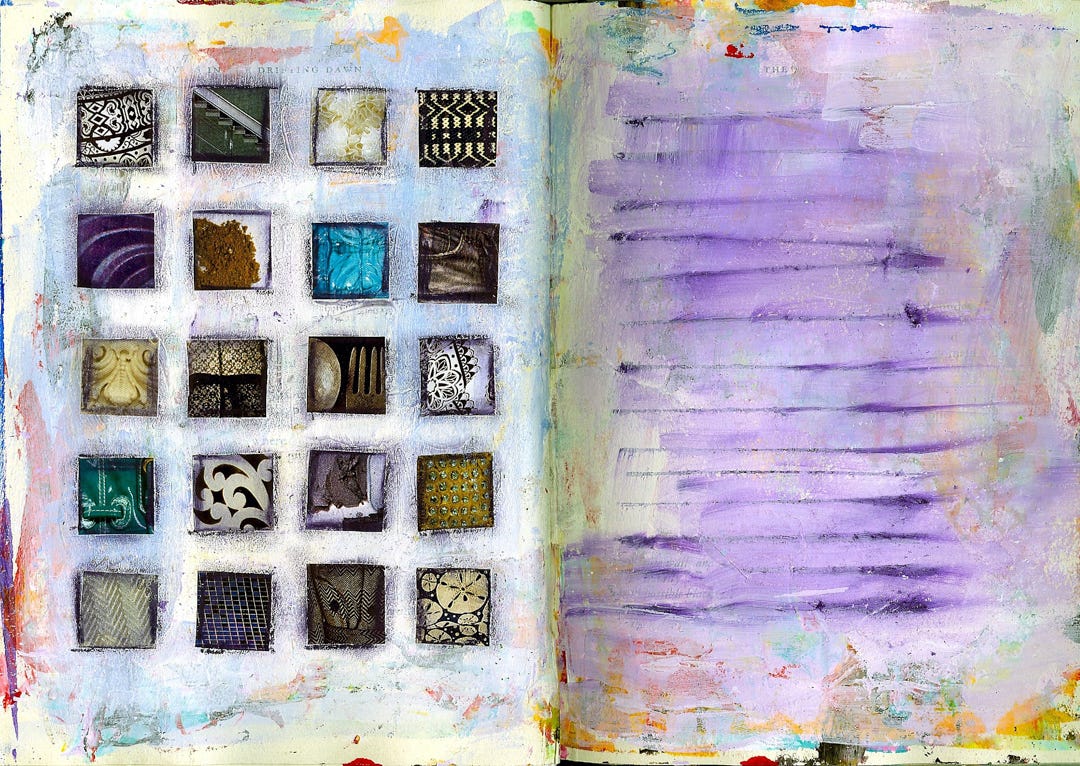
7x9” acrylics & collage in altered book, 2008
A grid is a type of constraint or limit. And limits invite idea generation.
A collection of images, typography, colors, observations, and moments. It is more than the sum of its parts. It’s an inviting structure for creativity. Grids are everywhere… in quilting, architecture, textiles, mosaics, pixel art, UX & web design, storyboards, data visualizations, graph paper, spreadsheets, and icons. They’re incorporated into game logic and maps. A grid of squares without spaces between is a type of tessellation1.
My daughter’s inktense blocks:
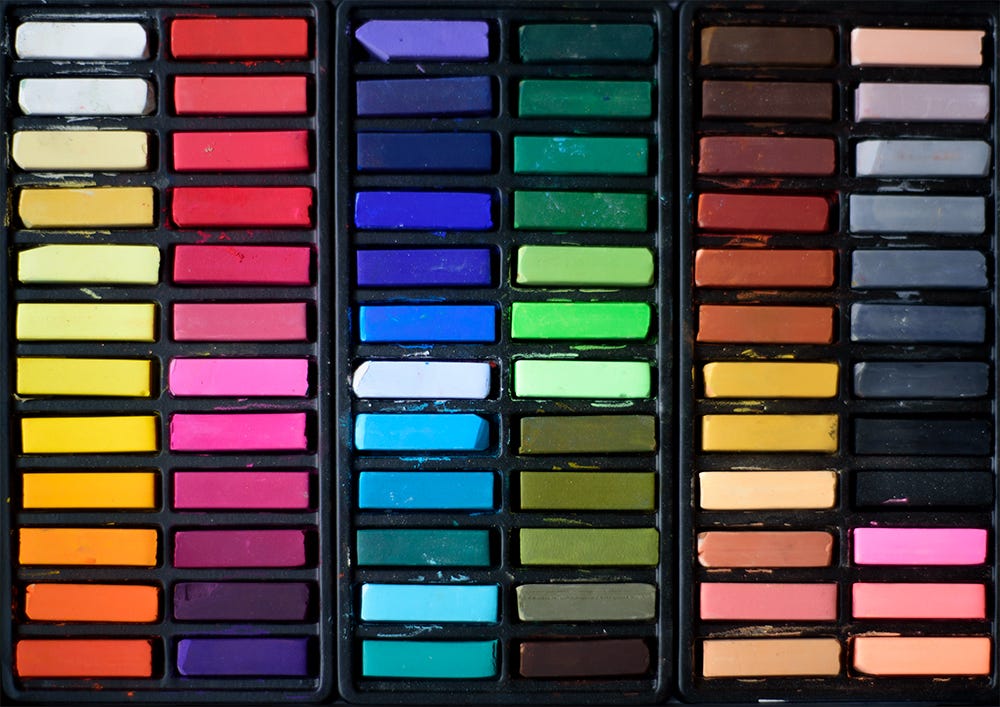
The grid creates a sense of order and helps you corral even the most chaotic elements.
Each space is a tiny experiment. Rarely do I plan in advance or decide what goes where! A grid feels welcoming even for those who work in a loose, improvisational way. It gives you a map, some visual scaffolding, little invisible arrows pointing this way or that. Trail markers to deftly navigate the quandary of composition. Mine aren’t precise. Rarely measured. Usually guesstimates & approximations. It’s a peaceful, calming (and visually balanced) design.
Pages from the long-running “black & white & grey {+stickers} drawing project” circa ②⓪①⑥ Since everything else is drenched in color, I decided to remove color as a variable. See notes re: color and Field Notes 05 Flip. With grids it’s easy to stop and start any time; I did this over several art sessions.
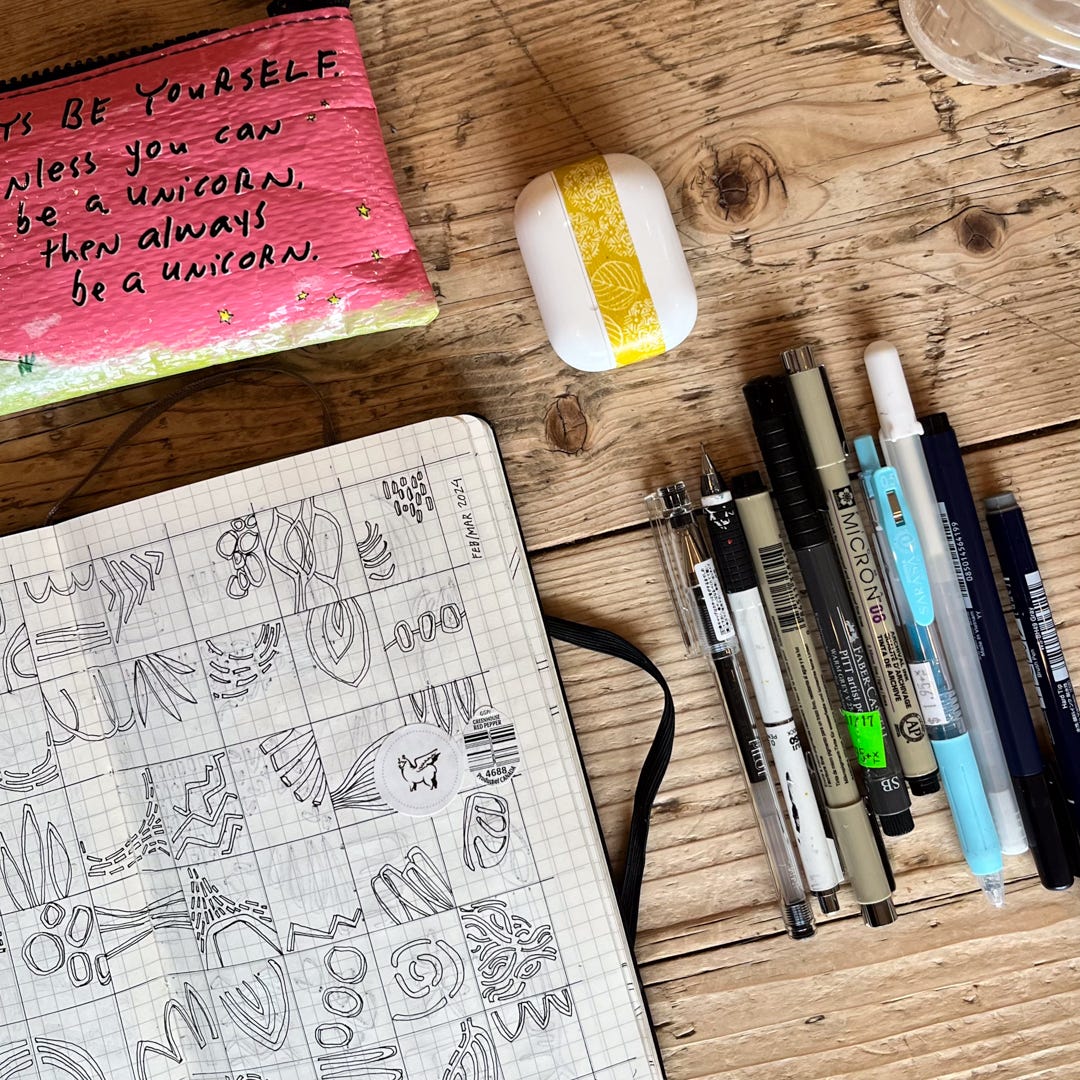
5x8” ink in moleskine, 2024
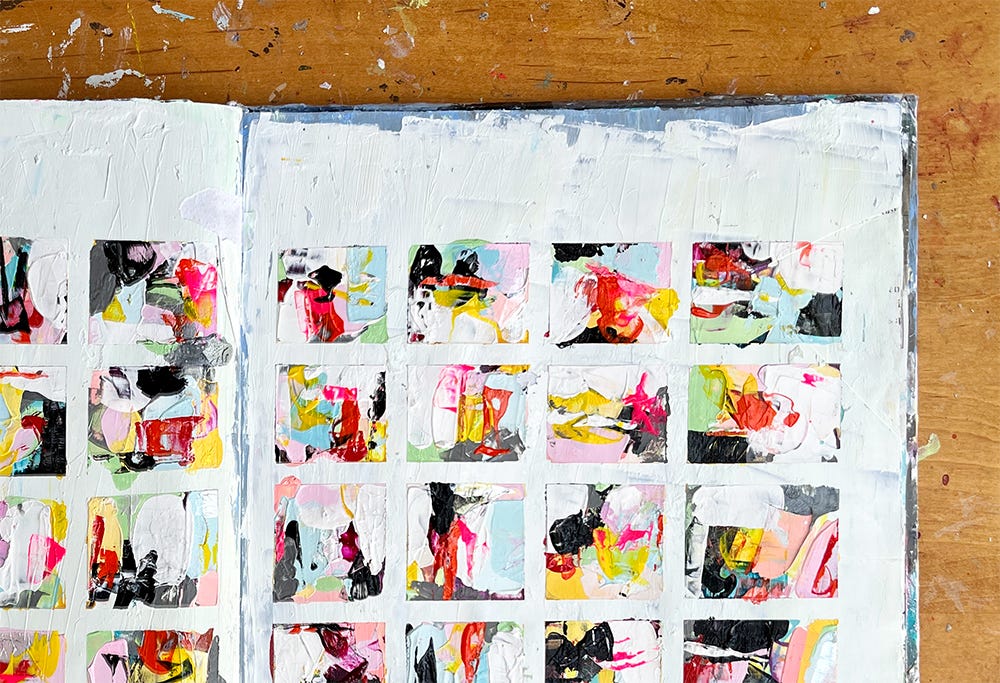
12x12” acrylics in altered book, 2023
“…whereas grids are not only spatial to start with, they are visual structures that explicitly reject a narrative or sequential reading of any kind”
From Grids by Rosalind Krauss, 1979
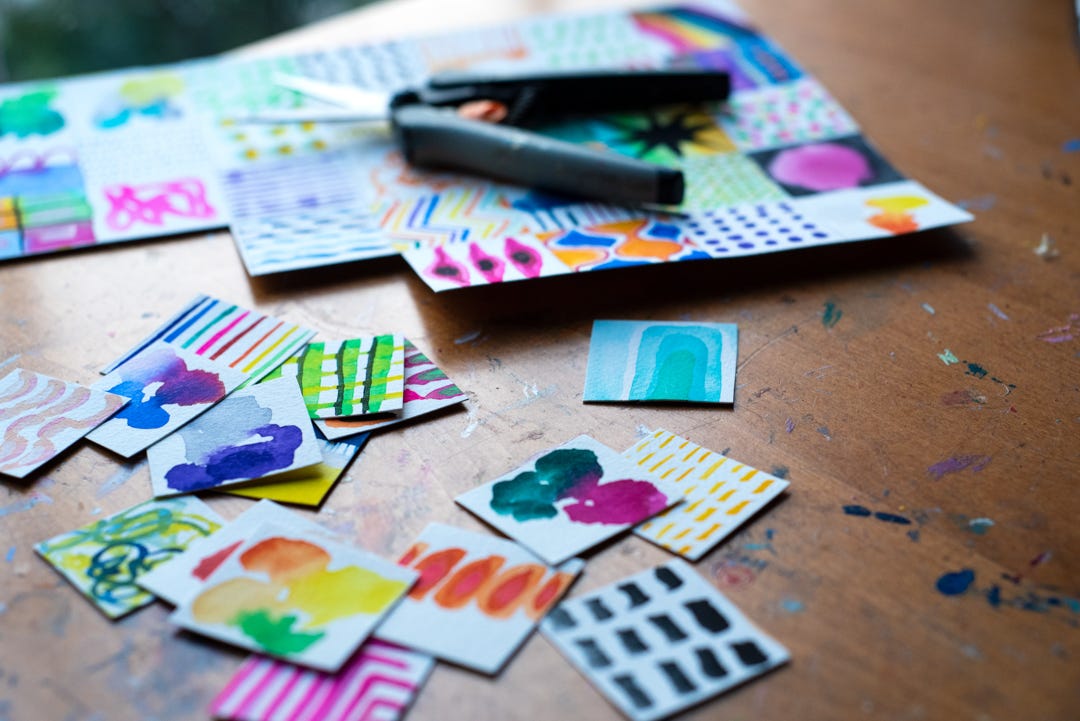
Paint mini abstracts in a grid and then ✂️ for collage. ⤴️ We’ll paint playful abstracts in my new watercolor/gouache workshop. 💁🏻♀️ If you haven’t done so yet, add yourself to the list to “let me know when it opens” and I’ll send you one email when we get started.
These might be candies or small gardens, any other ideas? I didn’t draw a grid, just left a margin of white space around the little compositions.
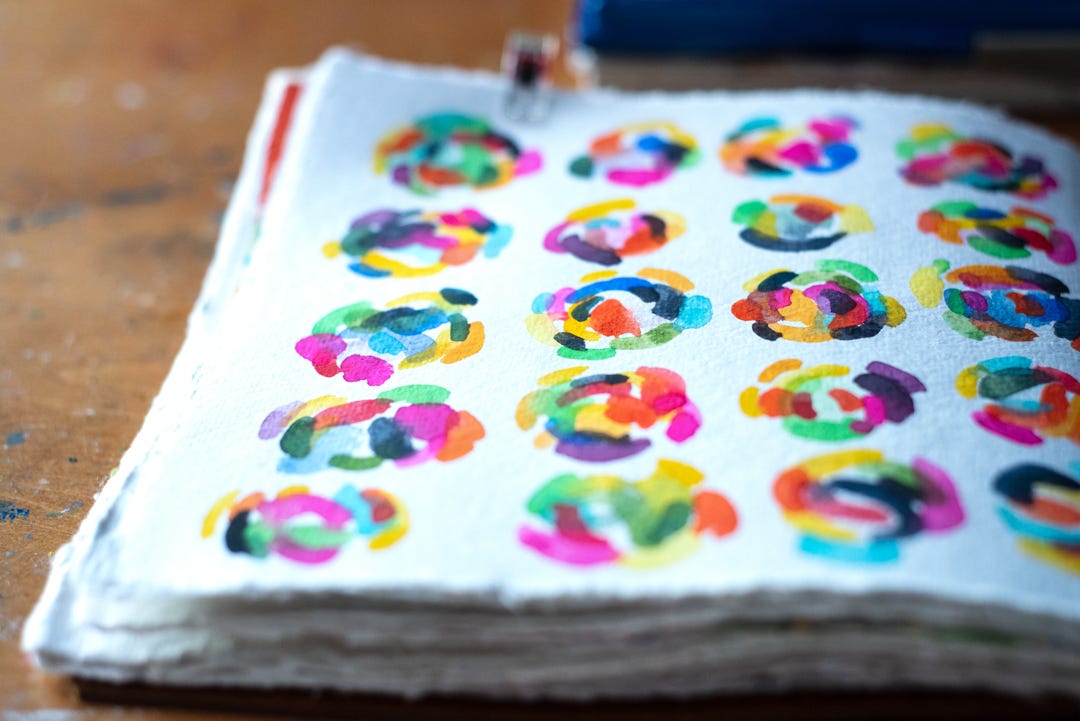
8x8” gouache on watercolor paper, 2026
The Guggenheim describes the work of Agnes Martin2: “The grid is a signature element of Martin’s artistic style, but there is nothing systematic about the way she used it. She shifted its scale and proportions from work to work, and her use of the form evolved over time.”
This next collage doesn’t look like a grid3 😉 but that’s how it started. You can go off-route, break the grid, take tangents, alter the grid, etc. And that’s the beauty of a grid — it’s a great starting point for explorations.
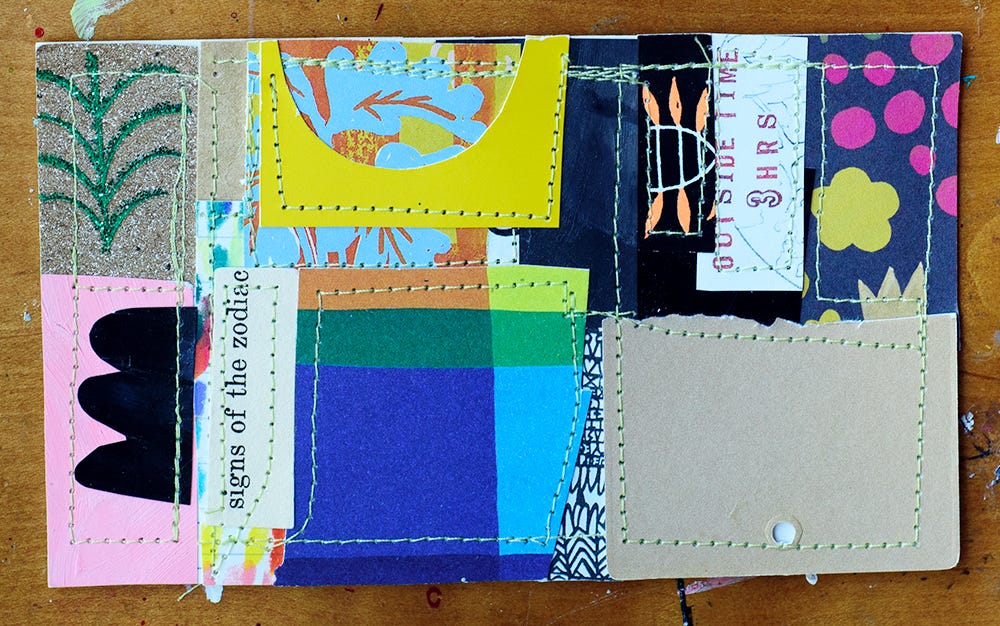
3x5” collage on index card, 2025
❝A grid feels welcoming even for those who work in a loose, improvisational way. It gives you a map, some visual scaffolding, little invisible arrows pointing this way or that. Trail markers to deftly navigate the quandary of composition. Mine aren’t precise. Rarely measured.❞
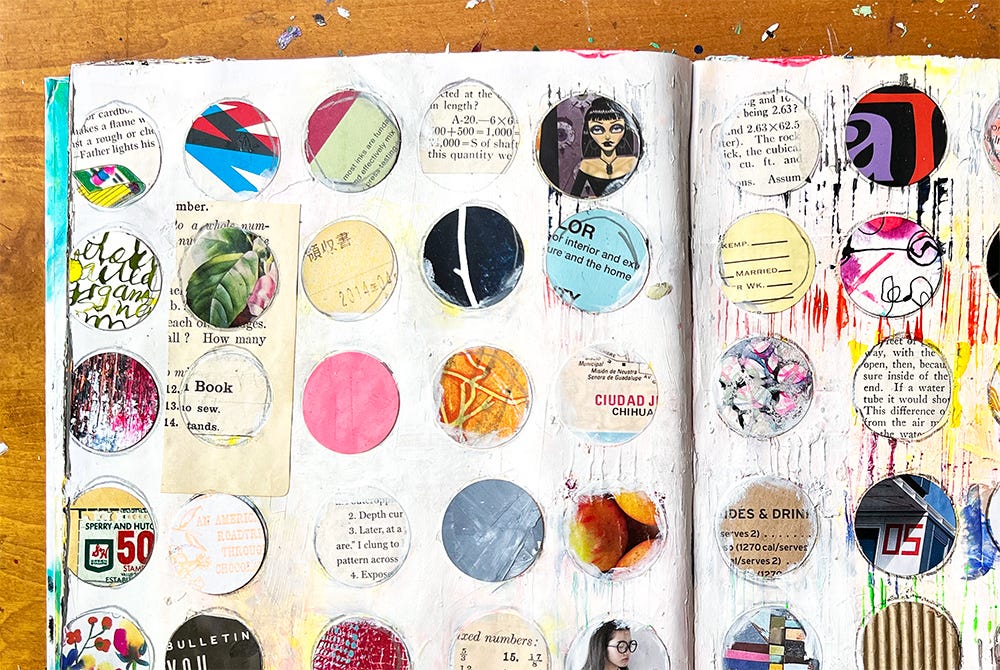
12x12” altered book, 2023
Per wikipedia, in graphic design, a “grid serves as an armature or framework on which a designer can organize graphic elements (images, glyphs, paragraphs, etc.) in a rational, easy-to-absorb manner.”
At Daisy Yellow
➜ Grids invite creativity (I guess I had a lot to say about grids; deep dive continues at the blog)
Painting 144 tiny patterns in my art journal
Do the calm+journal project
Fav pens for drawing, doodling & sketching
What’s your favorite way to use grids in your creative work? Sending hugs out to you over the invisible internet airwaves 🌀📻 because these are difficult times and nothing makes sense. I will continue to share words & art in the hopes of brightening your day. ❌⭕️❌⭕️
Tammy
You can unsubscribe via the link below.
Per wikipedia, a tessellation in 2 dimensions is a topic in geometry that studies how shapes, known as tiles, can be arranged to fill a plane without any gaps, according to a given set of rules. These rules can be varied. Common ones are that there must be no gaps between tiles, and that no corner of one tile can lie along the edge of another. […] There are only three shapes that can form regular tessellations: the equilateral triangle, square and the regular hexagon. Any one of these three shapes can be duplicated infinitely to fill a plane with no gaps.
Trivia: In a pentagonal tiling, each piece is a pentagon. There are currently 15 types; the 15th type was discovered in 2015. If you’re looking for ideas for repeating patterns & doodles, look into tessellation.
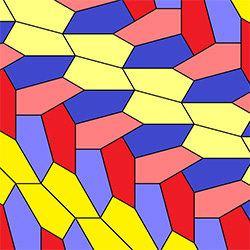
By Tomruen - CC BY-SA 4.0
https://commons.wikimedia.org/w/index.php?curid=42553713
From an art project about Agnes Martin at The Guggenheim: “Martin described her art-making process as beginning with time spent in her rocking chair, clearing her mind, and waiting for inspiration to hit. Next came many complex steps. She made extensive mathematical calculations and then small-scale studies and drawings. Finally, she would paint and draw in a larger format. After coating the surface of her canvas with oil paint (or acrylic, by 1964), she would draw lines with pencil, guided by a straightedge, or, perhaps, measuring tape or string stretched across the canvas. Though these lines appear straight and sharp from a distance, close up one can see how the pencil veered off course when it encountered irregularities on the surface of the canvas.”
If you noticed the discrepancy… you get <five ❺🦄🎰 unicorns>! I wish I could give you a lifetime supply of chocolate 🚲🍫🎟️🏭🕺🏻🎩🍭🍬👻🍄🫧🥼📺🛸 but I don't have a golden ticket. In the comments tell me your favorite flower and whether you’ve ever tried to draw it.
The circles remind me of the plastic pieces you used to put in the center of 45 records?
I’ve been trying to figure out how to make some art with hundreds of very old family images. I have lots of ideas. Unfortunately I have not even started to create anything with them because I tend to see too much meaning in everything, and this actually prevents me from ever starting projects!!!
Your newsletter came at the best time. I am going to make a grid of my ancestor’s faces. No meaning attached to it, but just a simple grid. A structure, like you wrote. Maybe I will add onto the structure and it will slowly evolve. I don’t know.
I’m just very relieved because I finally see a way forward. (I’ve been in a quandary and stuck for a long time. Your writing about grids is the thing that is helping free me. Thank you!!!!)